
Multidisciplinary Practice vs. Specialization
A Scientific view on the Greatest Debate in Talent Development

An article written by Sophie Herzog, Øyvind Sandbakk and Trond Nystad
A recent review published in Science, titled “Recent discoveries on the acquisition of the highest levels of human performance,” has summarized evidence from multiple domains on the acquisition of world-class performance[i].
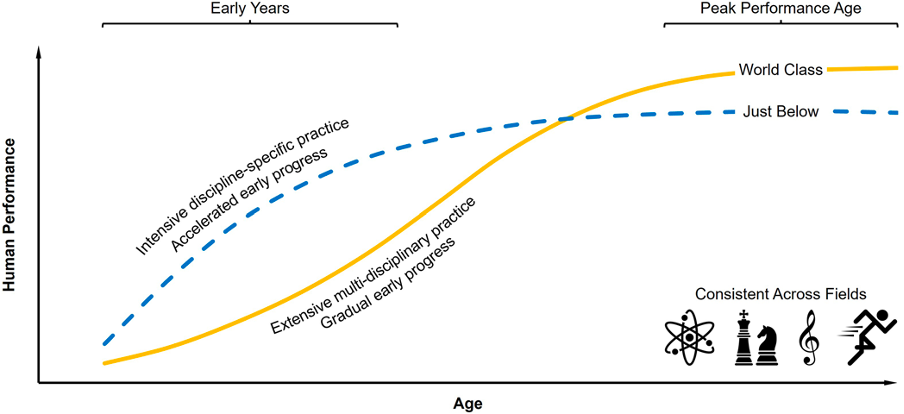
For decades, the “prodigy” narrative has dominated. The belief, that to become the next Olympic champion or world-class artist, one must select a discipline early and maximize specialized practice. However, this new research, synthesizing data from over 34,000 adult international top performers, across fields such as science, music, sport, and chess shows that children who stand out early and those who become world-class adults are usually not the same people. Early high performers tend to specialize very young, focus intensely on a single domain, and improve quickly at the start. In contrast, those who later become world-class performers typically show slower early progress, spend less time in narrow, discipline-specific training, and engage more broadly across multiple activities or disciplines before specializing.
The 90% Disconnect
The most striking discovery is that early exceptional performers and later adult world-class performers are largely distinct populations. Across sports, chess, and academia, nearly 90% of those who are top-ranked in their youth are not the same individuals who reach the world-class level as adults.
In fact, the study reveals a negative correlation between early and late success: world-class performers often demonstrated lower performance and more gradual progress during their early years compared to those who peaked just below them.
The Norwegian Approach
These findings provide a scientific “seal of approval” for the Norwegian approach to athlete development. Norway’s model is built on several key pillars that mirror the predictors of long-term excellence identified in the study:
Multidisciplinary Exploration and late selection: Opposite to many traditional programs, which aim to select the top-performing young people and push early specialization, Norway’s “Children’s Rights in Sports” framework encourages children to explore multiple sports, prioritizing enjoyment, skill variety and learning/mastery. The study by Güllich et al. shows that this – generally speaking – is a very successful approach: World-class athletes accumulated larger amounts of early multidisciplinary practice and smaller amounts of early discipline-specific practice compared to national-level peers.
Gradual Progression: Norway emphasizes mastery of skills over short-term results. Correspondingly, the research shows that the world’s best performers typically reached performance milestones (like first national championships) at older ages than their less-successful peers. Furthermore, a recent comparative analysis of world-class female cross-country skiers (we wrote about it here) found that a long-term, consistent year-to-year progression in training volume – rather than an aggressive early accumulation – was a key success factor[ii].
Holistic Development: Norway focuses on the social, mental, and physical well-being of the athlete. This aligns with the “limited-risks hypothesis” (see below) proposed by the researchers, which suggests that multidisciplinary engagement protects against burnout, overtraining, and overuse injuries.
The Risk of Early Specialization
As an opposite approach, the case study of Martin Ødegaard represents a “Tiger Woods” (or another famous example is musician Wolfgang Amadeus Mozart) trajectory. Unlike the “multidisciplinary practice” model, Ødegaard never participated in other organized sports, reaching 10,000 hours of soccer-specific training by age 13.3[iii] and therefore involved an early start, specific focus on one discipline, and maximized practice.
The “early bloomer” approach can in some cases foster young high-achievers, however, it frequently comes at the expense of long-term potential. The Science study suggests that while these “prodigy” pathways are common among those who are elite as juniors, they are infrequent (~10%) among those who become the world’s best as adults.
Why Multidisciplinary Practice often Wins: Three Key Hypotheses
So, how can this recent evidence be explained? Why does a varied background more often lead to higher peaks? The researchers suggest three reasons:
Search-and-Match: Experiencing various disciplines increases the odds that an athlete finds the one discipline optimally suited for their specific talents and preferences, which in turn increases the chances to develop high-performance.
Enhanced Learning Capital: Diverse learning experiences foster more flexible thinking, improve the ability to recognize underlying problem patterns, and support the integration of ideas, insights, and methods from different domains when exploring multiple solutions. In other words, what the authors call enhanced “learning capital”, is just another way of saying that exposure to varied experiences makes an athlete a more effective learner in the long run.
Sustainability: By limiting early single-discipline focus, athletes reduce risks that may impair or prematurely end a career. These risks include imbalances between training and recovery that can lead to overuse injuries, cumulative fatigue, overtraining, or burnout, or simply other high opportunity costs, such as sacrificing time with family, friends, education, hobbies, losing enjoyment and so on. In contrast, early multidisciplinary engagement can preserve elements such as enjoyment, curiosity, and intrinsic motivation, thereby increasing the likelihood of long-term participation and career sustainability.
What This Means for You?
At MYRA, we live the Norwegian motto “the most, for the longest, in the best possible way”, and help organizations and parents move away from the “selection by early performance” trap and shift their focus to empowering athletes with athlete literacy that can range from “World Champion” to “championing the world”. As this most recent study showed, top early performance is not a sensible criterion for identifying long-term potential. Instead, we advocate for above-average (but not necessarily top) early performance combined with variety and fun.
To foster the next generation of champions, we must allow our young athletes the time to develop, or even be “slow bloomers”. By prioritizing multidisciplinary play and gradual growth, you can help to build careers that last.
Each child develops at their own pace - physically, cognitively, emotionally, and motivationally. Children and young people are not “miniature” adults, and treating them as such risks misalignment between challenge and readiness. Developmental programs must therefore create space for exploration, enjoyment, and appropriately scaled challenges that respect individual differences.
A focus on mastery rather than short-term outcomes is central to this approach. Developing skills demands just as much attention, structure, commitment, and intentional practice as programs built around winning – the only difference is in what is valued. A program which focuses on mastery emphasizes the process of learning and developing. Children are actively involved in the process, continuously acquiring new skills and competencies that extend beyond athletic performance.
These include personal and social skills such as discipline, communication, being a good team player, responsibility, reliability, respect, empathy and enjoyment. Mastery in these areas supports not only athletic development but also broader human development, helping young people build foundations that last well beyond sport.
With this perspective, the goal of youth sports shifts from early selection and short-term success to long-term participation, development and fulfillment. The following guidelines outline principles for designing programs that aim to engage as many children as possible, for as long as possible, while supporting each individual in reaching their full potential.
Guideline for: “As many as possible, for as long as possible where everyone reaches their potential”
Recruit and retain more children and youth in your training group.
Be inclusive and adaptable to different abilities, backgrounds, and developmental stages.
Work together with other sports (e.g., soccer or track and field in the summer and skiing in the winter).
Work with local schools to support education around training and athletic/physical literacy.
Prioritize fun and learning (mastery) over early specialization and winning.
Focus on developing the whole person alongside athletic skills.
See and hear each athlete – dignity and worth are not measured in millimeters, seconds, or medals.
Collaborate with parents to build shared understanding of child-centered development.
Be patient.
Educate children, parents and coaches on training principles, biological age, puberty, maturity, goal setting, nutrition and recovery.
Empower children to develop independence and ownership of their learning and training.
Create environments of trust and psychological safety.
Thank you for your support!
[i] Arne Güllich et al. ,Recent discoveries on the acquisition of the highest levels of human performance.Science390,eadt7790(2025).DOI:10.1126/science.adt7790
[ii] Staff, H., Solli, G.S., Welde, B. et al. Long-Term Development of Training Characteristics and Physiological Determinants in World-Leading and Medal-Winning Female Cross-Country Skiers: A Three Decade Comparative Analysis. Sports Med - Open 11, 142 (2025). https://doi.org/10.1186/s40798-025-00939-1
[iii] Tønnessen E, Sandbakk SB, Apold-Aasen S, Sandbakk Ø, Haugen TA. The training and development process during childhood and adolescence of a multiple Ballon d’Or-nominated soccer player. Front Sports Act Living. 2025 Dec 11;7:1710194. doi: 10.3389/fspor.2025.1710194. PMID: 41458101; PMCID: PMC12738862.